
How to teach multiplication and division with objects before times tables
- Math
Your child can add and subtract, and now times tables have come home. To teach multiplication, start with equal groups of real objects, like snacks or blocks, then skip counting and arrays. Teach division as sharing objects into equal groups. Times tables come once the meaning is clear.
Flash cards are an easy place to start, since the facts are what the worksheet asks for. This post covers how to teach multiplication one step before the flash cards, with objects your child can hold and move, so each fact means something before it's memorized. Division comes right after, with the same objects. If adding and subtracting with objects is still new, start with how to use math manipulatives at home.
We teach this one-on-one in homes across Dallas: see in-home math tutoring.
How to teach multiplication, step by step
Everything here works with snacks, blocks, or coins you already have. Each step builds on the one before it, and the sections below cover them in order.
- Make equal groups. Set out 3 plates and put 4 grapes on each. That's 3 × 4: 3 groups with 4 in each.
- Add the groups. Your child adds 4 + 4 + 4 to find the total, 12. This repeated addition is the bridge from the adding your child already knows.
- Skip count. Point to each plate in turn and count by 4s: 4, 8, 12. Each number your child says is the total so far.
- Line the groups up in an array. Lay the 12 grapes out in 3 rows of 4, then turn the rows the other way. It's 4 rows of 3 now and still 12, so 3 × 4 and 4 × 3 have the same answer.
- Draw it, then write it. Your child draws 3 circles with 4 dots in each and writes 3 × 4 = 12 under the drawing. Over time, the drawings get smaller and then drop away.
- Practice the facts. Once your child can show what a fact means, practice a few facts at a time with flash cards or a short worksheet.
Division uses the same groups, so its section comes right after arrays, before paper.
Why memorized times tables break down when a problem looks different
A memorized fact is a sentence your child has learned to say back: "three times four is twelve." That holds up well on a flash card, and less well when a problem looks different from the card.
Picture a 3rd grader who can recite the 4 times table in order. Her word problem says that Sam has 3 bags with 4 apples in each bag, and she writes 3 + 4 = 7. She knows 3 × 4 = 12. What she hasn't connected yet is that 3 bags of 4 apples is what 3 × 4 means. The same gap shows up when a fact slips her mind on a test. If she only memorized 6 × 4, she has nothing to go back to. If she knows 6 × 4 means 6 groups of 4, she can count by 4s, or add one more 4 to the 5 × 4 she already knows.
Of course, your child will need quick recall of the facts eventually. A child who stops to count every fact has less attention left for the new step in a longer problem. But facts are easier to remember when your child knows what they mean, and a forgotten fact can be worked out again. The cost is time: this way takes longer at the start than flash cards do, and the facts still need practice afterward. If your child is already struggling with times tables, the way to teach multiplication is the same: go back to the objects first, then return to the facts.
Equal groups and repeated addition: what multiplication means
The first idea to build with objects is equal groups. 3 × 4 means 3 groups with 4 in each. Set 3 plates on the table, put 4 grapes on each plate, and your child is looking at 3 × 4.
The word "equal" matters. If one plate ends up with 5 grapes, the plates no longer show 3 groups of 4, and the total won't be 12. Let your child spot the plate with 5 and take one grape off, because 3 × 4 stands for groups that are all the same size.
To find the total, your child can add the groups: 4 + 4 + 4 = 12. That's repeated addition, and it's the bridge from the adding your child already knows to multiplying. Then show how 3 × 4 = 12 says the same thing in fewer words. Some classes read 3 × 4 as 3 groups of 4 and some as 4 groups of 3. Use the way your child's class says it, since the total is 12 either way.
Equal groups multiplication is still its own step, even though it grows out of adding. In 3 + 4, both numbers count the same kind of thing. In 3 × 4, the numbers do different jobs: the 3 counts groups, and the 4 counts what's in each group. Keeping two kinds of counting in mind at once is new for a child, and the plates and grapes help by keeping the two numbers physically apart.
Skip counting and multiplication arrays: faster ways to count equal groups
Adding 4 + 4 + 4 works, but it gets slow with 8 groups of 4. Skip counting speeds it up. Point to each plate in turn and count by 4s: 4, 8, 12. Skip counting adds a whole group at a time, so each number your child says is the total so far. Practice it out loud on its own, too, the way your child once practiced counting by 1s.
Multiplication arrays line the same groups up in rows. Take the 12 grapes off the plates and lay them out in 3 rows of 4. Now every group is in view at once, and the even rows make it easy to count by 4s down the side.
Then rotate the array so the rows run the other way. It's now 4 rows of 3, and the grapes haven't changed, so the total is still 12. That's why 3 × 4 and 4 × 3 have the same answer, and it means each fact your child learns comes with a partner fact.
How to teach division by sharing and taking away equal groups
Division uses the same groups, worked from the other end. Your child starts with the total and works out the groups. There are two ways to ask a division question, and children need to see both.
Sharing into equal groups. You have 12 crackers and 3 plates. How many go on each plate? Your child deals the crackers out one at a time, one to each plate, around and around, until the pile is gone. Then they count one plate and find 4. Sharing often makes sense to children first, because it's how they already split a snack or deal cards.
Taking away equal groups. You have 12 crackers, and each bag holds 3. How many bags can you fill? This time your child takes a group of 3 away from the pile, then another, and counts the groups as they go: 4 bags. Taking groups away is repeated subtraction, the reverse of the repeated addition from before.
Both questions are 12 ÷ 3, and both answers are 4, but they look different to a child, and word problems use both. Then try 13 crackers. After sharing, 1 cracker is left over, sitting right there on the table. That's a remainder, and a child who has seen one with crackers usually has an easier time with remainders on paper.
Moving from objects to drawings to numbers on paper
Paper comes after the objects, with a drawing in between. After building 3 plates of 4 grapes, your child draws 3 circles with 4 dots in each, then writes 3 × 4 = 12 under the drawing. A drawing is quicker than building, it fits on a worksheet, and your child can still count it if they get stuck. For division, they draw the total as dots and circle the groups.
Over time, the drawings get smaller and then drop away. You'll see a few signs that your child is ready to work with numbers alone:
- They can say what 3 × 4 means in their own words, like "3 groups of 4."
- They can build or draw a problem from the number sentence without help.
- They guess the total before counting, then check it.
- They can make up a quick story for a fact, like 3 dogs with 4 legs each.
- They can pick out which of two drawings shows 12 ÷ 3.
If one of these is still shaky, stay with drawings or objects a little longer, and come back to the numbers once the drawing feels easy.
How to teach multiplication facts once your child knows what they mean
Once your child can build or draw a fact without help, they're ready to practice the facts themselves. In our sessions, that practice is flash cards and worksheets, with the mix depending on your child's age. At home, practice a few facts at a time with flash cards or a short worksheet, and stop while your child is still enjoying it.
Each fact your child practices comes with a partner. Turning the array showed that 3 × 4 and 4 × 3 are both 12, so knowing one gives your child the other.
When a fact slips, your child can work it out again. If 7 × 3 won't come, they can count by 3s, or add one more 3 to the 6 × 3 they already know. When the same fact keeps slipping, build or draw it again before more practice.
Multiplication and division activities to try at home
The object work fits into snacks, chores, and games you already have at home. Each of these takes a few minutes. Let your child do the moving and the counting.
- Snack plates. Set out 3 plates and ask your child to put 5 crackers on each. Ask how many there are in all and how they figured it out, then write 3 × 5 = 15 together.
- Egg carton arrays. An egg carton is already 2 rows of 6. Fill it with cereal pieces or pasta and ask how many rows, how many in each row, and how many in all. A muffin tin works the same way.
- Coin counting. Count nickels by 5s and dimes by 10s. Each coin is a group, so 4 nickels is 4 groups of 5.
- Table setting. If 4 people each need a fork, a spoon, and a napkin, how many things go on the table? Let your child set it and count by 3s.
- Dealing cards. Before a card game, have your child deal 12 cards to 3 players and count one hand. That's sharing into equal groups.
- Bagging toys. Give your child 20 blocks or small toys and ask how many bags of 5 they can make. That's taking away equal groups.
If practice turns into an argument, stop for the day and try again another time.
How to teach multiplication to a child with ADHD or autism
A child with ADHD or autism can learn multiplication with the same steps, in the same order. What changes is how practice is set up. These ideas come from how we plan our own sessions.
- Keep each activity short. In our sessions, younger children and kids who need more breaks work in blocks of 5 to 10 minutes, with a different activity in each and a break after 2 or 3 activities. At home, one snack-plate problem or one array can be a whole block.
- Give your child something to move. Dealing crackers onto plates or laying grapes out in rows gives your child something to hold and move while they think, and it keeps the problem in front of them.
- Put the harder part first. Try a new fact or a new kind of problem while your child is fresh, and end with one they already know, so practice finishes on a win.
- Ask for one more very short task. When your child hits their limit, ask for one more task that takes under 2 minutes, like filling one more plate of 4. Praise them for finishing it, then give a short break.
- Try a different method. If plates and grapes don't hold your child's attention, try block cubes they can build and take apart, small toy animals for a child who loves animals, or drawing the groups out. Notice which one your child reaches for.
How we teach multiplication and division at Cedar Elm
We teach this step with objects your child can play with and move, the same way we teach adding and subtracting. One of our subtraction worksheets carries a note printed for the tutor: if the child gets stuck, build the problem with pom-poms first, then cross out the pictures. Multiplication and division follow the same pattern. Your child puts objects into equal groups, often lined up in rows. For division, they share objects into equal groups first, then take groups away. Then they work the same kind of problem on paper. Once the idea is solid, your tutor moves to more traditional practice, like flash cards and worksheets, depending on your child's age. Our method page explains why hands-on work comes before paper.
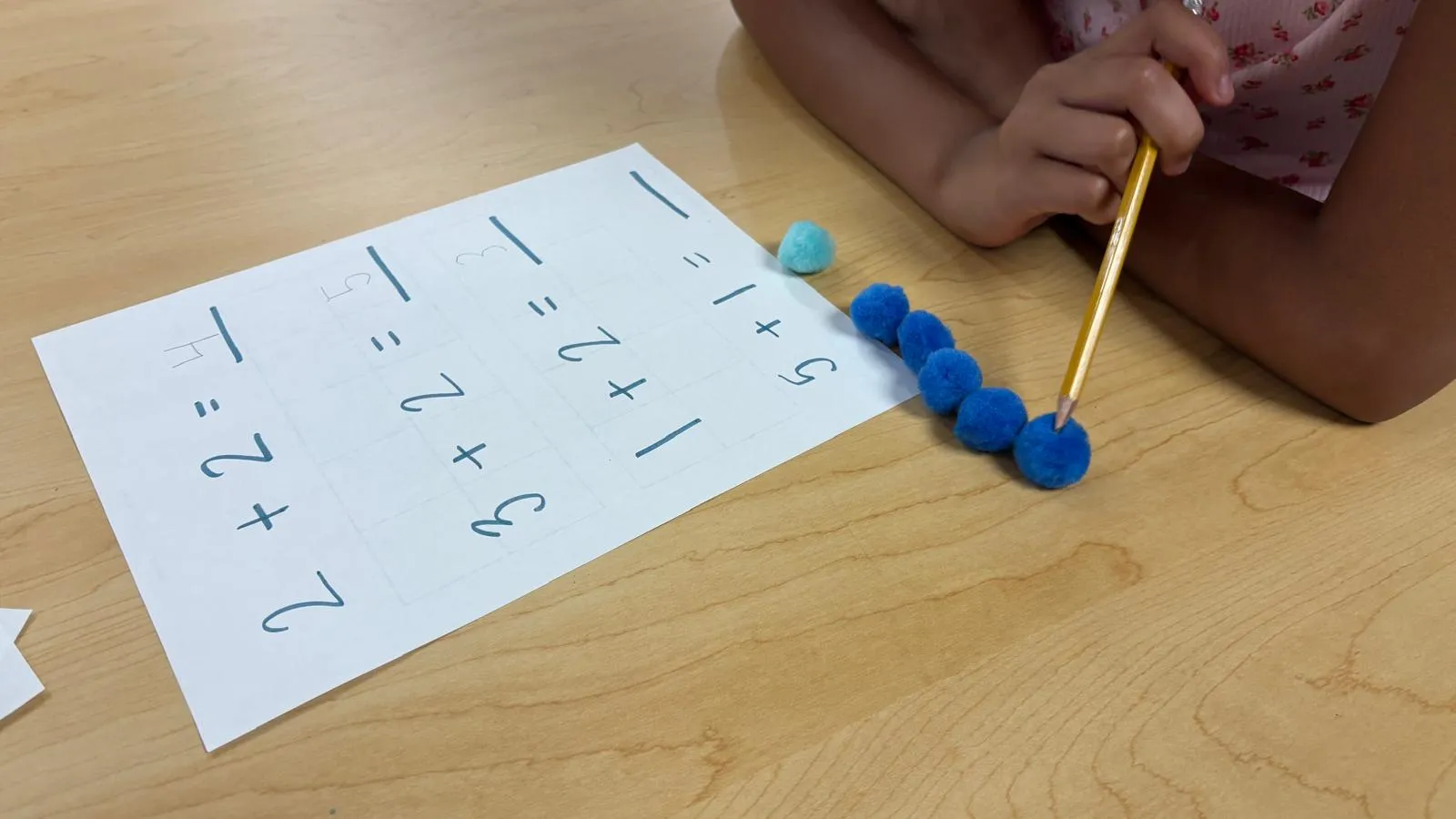
We try more than one method to see which one makes sense to your child, with pom-poms, blocks, Play-Doh, drawing, and games. Your tutor starts at the level your child is working at now and makes custom worksheets for the skills they need next. Younger children and kids who need more breaks work in short blocks of 5 to 10 minutes with planned breaks, which is part of how we teach kids with ADHD and autism. With older students, your tutor explains a couple of example problems, then your child tries more on their own. Your tutor checks which ones they can get right without help and explains the rest again, often with their current homework. After every session, you get a note on what your child worked on.
This way of teaching comes from my own work before Cedar Elm: 3 years tutoring at a tutoring center, and a year as a Registered Behavior Technician (RBT) working one-on-one with autistic children at an ABA clinic. We tutor in homes in Dallas and nearby cities, from Pre-K counting through high school Geometry. Multiplication and division also run through STAAR math in grades 3 to 8, and our STAAR test prep uses a released practice test about once a month to find the topics that need work. If multiplication or division is where math homework has stalled, our in-home math tutoring starts with a free consultation, where your tutor sees what your child already knows.
