
Our specialty
In-home tutoring in Dallas for kids with ADHD and Autism
There is nothing wrong with your child. If something isn't working, we change how we teach until it does.
Cedar Elm was founded by Mariya Zakir, a former Registered Behavior Technician who spent a year working one-on-one with autistic children at an ABA clinic. We tutor children with autism, ADHD, an IEP, a 504 plan, or other special needs in their homes across Dallas and nearby cities.
Read our story
Is Cedar Elm a good fit for your child?
Families usually contact us when:
- Your child is autistic, has ADHD, or has a hard time focusing and staying with a task
- Schoolwork brings on frustration or shutdown
- Your child has an IEP or 504 plan, gets special education services, or receives speech therapy, OT, ABA, or counseling
- Your child needs to build the basics first: sitting at a table, following directions, finishing a task
- Your child communicates in their own way, including children who are nonverbal
- You've tried other tutors before without much progress
We rarely turn a family away. If you're not sure whether it's a fit, we can try one session and see how your child responds.
How we teach kids with ADHD and Autism
-
Hands-on materials
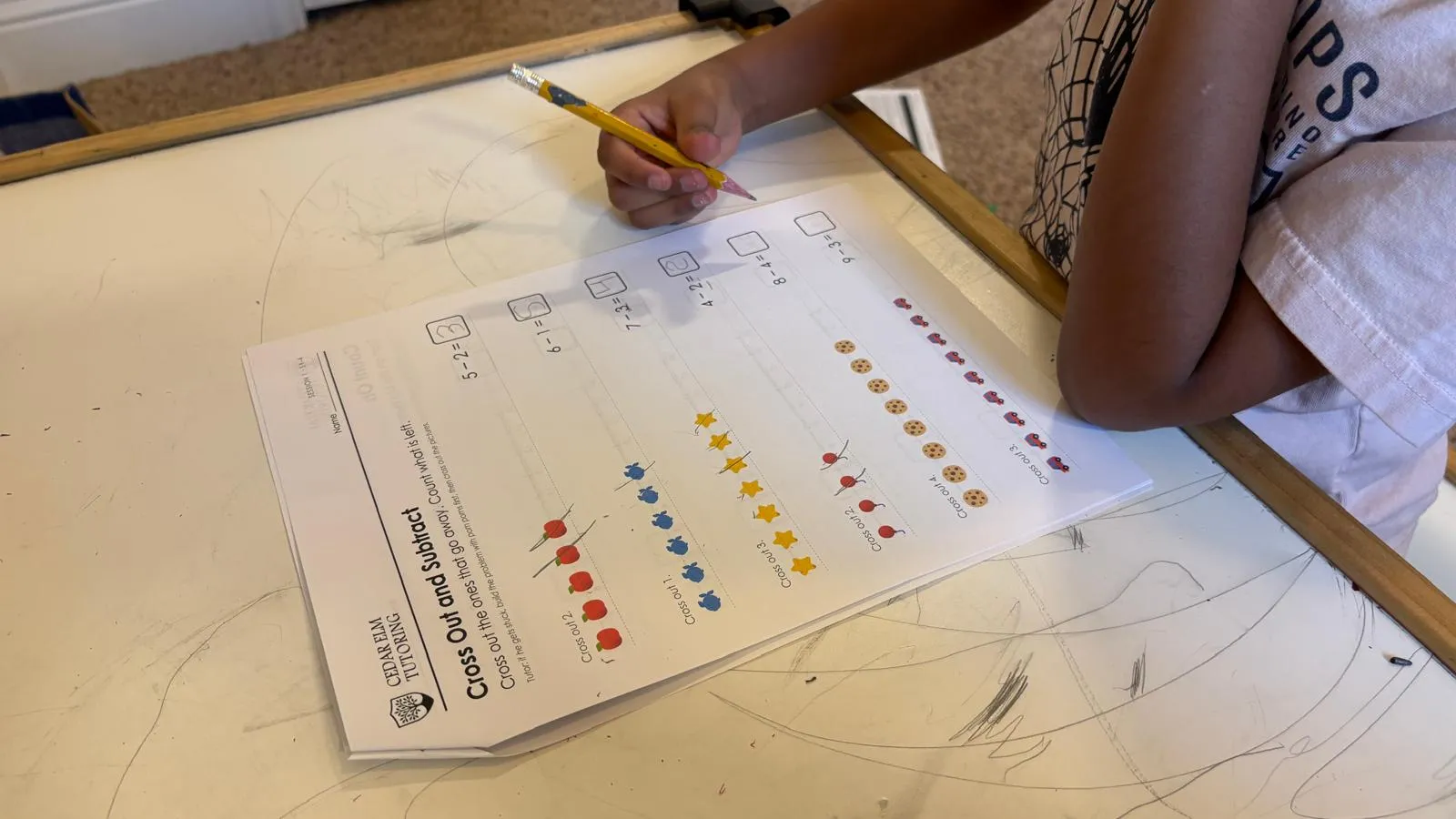
For younger children, your tutor uses pom-poms, blocks, Play-Doh, drawing, and games instead of starting on a worksheet. A child might build a subtraction problem with pom-poms, take some away, and count what's left, before doing that same problem on paper. Holding the idea first makes it easier once it's just numbers on a page.
-
Short activities with planned breaks
For younger children and kids who need more breaks, sessions run in blocks of 5 to 10 minutes, usually 2 or 3 activities and then a break. The break comes on a schedule, not only after a meltdown, and most children end up working longer overall because they aren't fighting through frustration to get there.
-
A first-then board and a timer
When a child has a hard time focusing, your tutor makes a first-then board for the session. It shows what comes first, the activities in order and how many worksheets, and then the reward your child is working toward. A timer shows how much time is left, so the end of the work is something your child can see, and that helps them keep going. If your child already uses a board at ABA or at home, tell us, and your tutor will set it up the same way.
-
Praise and small rewards
Your tutor points out good work as it happens and uses praise and small rewards, sometimes with a token board your child fills in toward a reward. Over time, most children start wanting to do well for their own sake, not only for the reward.
-
Why we teach this way
The breaks and rewards above are strategies our founder learned at an ABA clinic. We use them to help children learn academic skills.
Cedar Elm is a tutoring service, not an ABA provider.

Why is my child playing with Play-Doh in a math session?
Because building the problem with their hands usually comes before solving it on paper. Once a skill is solid with pom-poms or blocks, we move it to a worksheet. If the worksheet is the only part you see, ask your tutor to show you what came before it.
Building learning readiness before reading and math
Some children need to work on sitting at a table, paying attention, following directions, and finishing a short task before reading or math instruction really lands. For these children, early sessions focus on readiness, and academics get added in as they're ready. Your tutor also spends this time learning how your child communicates and how they best show what they know.
Early math and early writing
Many families come to us as their child finishes ABA and is ready for more schoolwork. With these children, we usually start with counting, skip counting, adding and subtracting, telling time, tracing, holding a pencil, and forming letters.
Kindergarten readiness tutoring and checklist Pre-writing activities to try at home
Catching up to grade level
If your child is working below grade level, we start at the level they're actually at and build toward grade level one step at a time.
My child's worksheets look like an earlier grade's work. Is that normal?
Yes. We teach the skill your child is ready for, not the grade printed on their report card. As the earlier skills lock in, the work moves up toward grade level.
What early progress can look like
- Sitting at the table a little longer
- Coming back to work after a break
- Finishing a short task without help
- Less frustration at homework time
Preparing your child for a new person
A new adult in the house is hard for some kids. These steps help, especially before the first visit.

-
Tell them ahead of time, in plain words
Something like: "On Tuesday, a teacher is coming to our house. You'll do some activities at the table, and I'll be there the whole time." Say it a few times in the days before, when your child is calm, not right as your tutor is walking in.
-
Add it to their visual schedule
If your child uses a visual schedule, add the visit to it. A short social story, a few sentences and pictures about what will happen, works well for some kids too.
-
Use "first, then" if your child already uses it
"First we meet the tutor, then snack" turns a new event into something more familiar.
-
Don't call it a test
The first visit isn't graded, and there's nothing to study for. It's mostly your tutor getting to know your child through an easy activity.
-
Tell us what your child loves
A favorite toy, character, game, or activity helps your tutor connect with your child early and find out what motivates them.
-
Pick a good time of day
If you can choose, book the visit for a time your child is usually settled, not right after school or right before dinner.
-
If the first visit is rough
Some kids are shy, upset, or want nothing to do with a new person at first. Your tutor lets them warm up at their own pace. A hard first meeting doesn't mean tutoring won't work.
What happens when your child gets upset or refuses to work
When a child gets upset or won't keep working, your tutor stays calm and asks for one more task, something under 2 minutes. Once it's done, your tutor praises the effort and gives a short break.
Because the break comes right after a finish, not in the middle of a refusal, most children come back to the work more focused than before.
Your child is never made to feel like they're difficult to work with.
How tutoring fits with an IEP, a 504 plan, and therapy
We work with children who have an IEP or 504 plan, and with children who get speech therapy, OT, ABA, or counseling.
Tutoring runs alongside these services. It doesn't replace them.
What's helpful to share with your tutor
We're a tutoring service. We don't diagnose, and we don't provide ABA therapy, speech therapy, OT, or counseling. If your tutor thinks your child would benefit from an evaluation or another service, we'll tell you.
What we teach kids with ADHD and autism, Pre-K to high school
We tutor reading through 8th grade and math through high school Geometry, and we help with homework in any subject. Every session is adapted to your child, from hands-on materials for younger children to clear explanations and guided practice for older students.
-
Math tutoring, from counting to Geometry
From counting and telling time to fractions, pre-algebra, Algebra 1, and Geometry, starting at the level your child is working at now.
-
Reading tutoring, Pre-K to 8th grade
Phonics, fluency, and reading comprehension. Early writing, from tracing to first sentences, is practiced in reading sessions too.
-
Kindergarten readiness tutoring
For children in Pre-K or getting ready for kindergarten: counting, tracing, holding a pencil, colors and shapes, and writing their first name.
-
STAAR test prep, grades 3 to 8
STAAR reading and math, practiced with released past tests. If your child gets extra time or breaks at school, your tutor practices with them too.
Guides for parents of kids with ADHD and autism
-
Math
How to teach multiplication and division with objects before times tables
Before times tables, multiplication starts as equal groups your child can hold. We show how to teach it, and division right after, using snacks, coins, and drawings.
-
Reading
How to teach reading comprehension at home, from one sentence to written answers
If your child reads every word but can't tell you what happened, comprehension may need to start smaller. These steps run from one sentence and a picture to written answers, with activities for home.
-
Math
How to use math manipulatives at home to teach addition and subtraction
Your child gets the right answers but can't show you how. Pom-poms, blocks, Play-Doh, and everyday objects can teach what adding and subtracting mean, and show whether the idea has clicked.
-
Kindergarten readiness
Pre-writing activities: how to help your child learn to trace and write
Writing takes hand strength, a steady grip, and the lines and circles that letters are made of. Here's how to practice each step at home, and when to ask an occupational therapist.
Questions from parents of kids with ADHD and autism
-
Do you tutor kids with ADHD?
Yes. Kids with ADHD are a big part of who we work with. Sessions run in short blocks with planned breaks and praise for finished work, which helps a child stay with a task longer. Older students who lose track of assignments also get a homework and study calendar.
-
Do you tutor autistic children?
Yes. Tutoring autistic children is part of our specialty. Our founder is a former Registered Behavior Technician (RBT) who spent a year working with autistic children at an ABA clinic. Your tutor uses the ABA-informed strategies she learned there, like short activities, planned breaks, and praise, and adapts every session to your child.
-
Do you work with nonverbal children?
Yes. We've worked with nonverbal children before. At the consultation and in the first few sessions, your tutor learns how your child communicates and how they show what they know best. Trying a session is really the only way to know for sure if it's a fit.
-
My child won't sit and do worksheets. Can you still work with them?
Yes, and it's the question parents ask us most. Your tutor doesn't start with a stack of worksheets. Sessions run in short activities, many of them hands-on, with breaks planned in, and a first-then board and a timer show your child what comes next and how long is left. Building focus is often the real work at first, and some children start with learning readiness before any reading or math.
-
We've tried other tutors and it didn't work. Why would this be different?
A lot of families come to us after exactly that experience. We teach one-on-one, use hands-on materials instead of only worksheets, plan breaks into the session instead of waiting for a meltdown, and praise finished work. The plan also changes as your tutor learns what actually works for your child.
-
What does "ABA-informed" mean? Do you provide ABA therapy?
It means your tutor uses teaching strategies, like short activities, planned breaks, and praise, that our founder learned at an ABA clinic. We don't provide ABA therapy ourselves. Tutoring runs alongside your child's ABA, speech, or OT services.
-
How much does tutoring cost for a child with ADHD or autism?
Tutoring is priced per 60-minute session in your home, at the same rate for every student, and the current rate is on our pricing page. The price includes custom materials made for your child, a session note after every session, and a monthly progress report. You choose how many sessions a week, you're billed monthly or every two weeks, and the first consultation is free. See pricing
-
Do you come to our home, or is tutoring online?
We come to your home, so your child learns in a familiar, comfortable space. All sessions are in person, and we don't offer online tutoring. We tutor in Dallas, Plano, Richardson, Garland, Carrollton, Addison, Farmers Branch, Irving, Coppell, Grapevine, Lewisville, The Colony, Little Elm, University Park, and Highland Park.
-
Can you tutor my other children too?
Yes, neurodivergent or not. Siblings can share a visit, with at least 30 minutes for each child. See how sibling visits work
Book a free consultation
The consultation is free. Your tutor comes to your home, spends time with your child through an easy activity, and talks with you about a plan.
Curious who comes to your home and what that first visit looks like? See our method