
How to use math manipulatives at home to teach addition and subtraction
- Math
Your child got every addition answer right but can't show you how. Use math manipulatives, small objects like pom-poms or blocks, so your child acts out each problem, then draws it, then writes the numbers. If they can show a problem with objects, they understand it.
Maybe you point to 6 + 3, ask how they got 9, and they shrug, or count again and land on 8. It's natural to wonder whether they understand what adding means or have learned the answers by heart. Manipulatives are a simple way to find out and a good way to teach the idea underneath.
We teach this one-on-one in homes across Dallas: see in-home math tutoring.
How can you tell if your child understands addition or has memorized it?
Here's a quick check. Take a problem your child has already solved on paper, hand them 10 or so small objects, and ask, "Can you show me?" If they build it right away, the meaning is there. If they aren't sure where to start, the objects are a good place to begin teaching.
On a worksheet, understanding and memorizing look the same, because a correct 3 + 4 = 7 is correct either way. The difference shows when the problem changes form: the same fact read aloud, written across the page instead of stacked, or told as a story about 3 ducks and 4 more that join them.
A child who understands addition and subtraction can usually:
- Show a problem with objects or a quick drawing, without being shown how
- Explain an answer in their own words, like "I had 5 and got 2 more, so it's 7"
- Spot an answer that can't be right, such as 8 - 3 = 11, because taking away should leave fewer
- Solve the same fact when it comes as a story
- Find a second way to the answer, like starting at 5 and counting up 2 instead of counting from 1
Of course, memorized facts are useful. A child who knows 6 + 3 by heart has more attention left for the next step of a harder problem. The trouble starts when a fact has no meaning behind it, because then it's hard to use once the problem looks different.
If "Can you show me?" stalls your child on more than one problem, in-home math tutoring can start from there.
What are math manipulatives, and how do they help with adding and subtracting?
Math manipulatives are objects a child moves by hand to act out a math idea. Classrooms often use counting bears, linking cubes, and base-ten blocks, and stores sell them in kits. You can also start with what's already in your house: pom-poms, blocks, Play-Doh, buttons, dry pasta, cereal pieces, spoons, or toy cars. Anything your child can count and move will work.
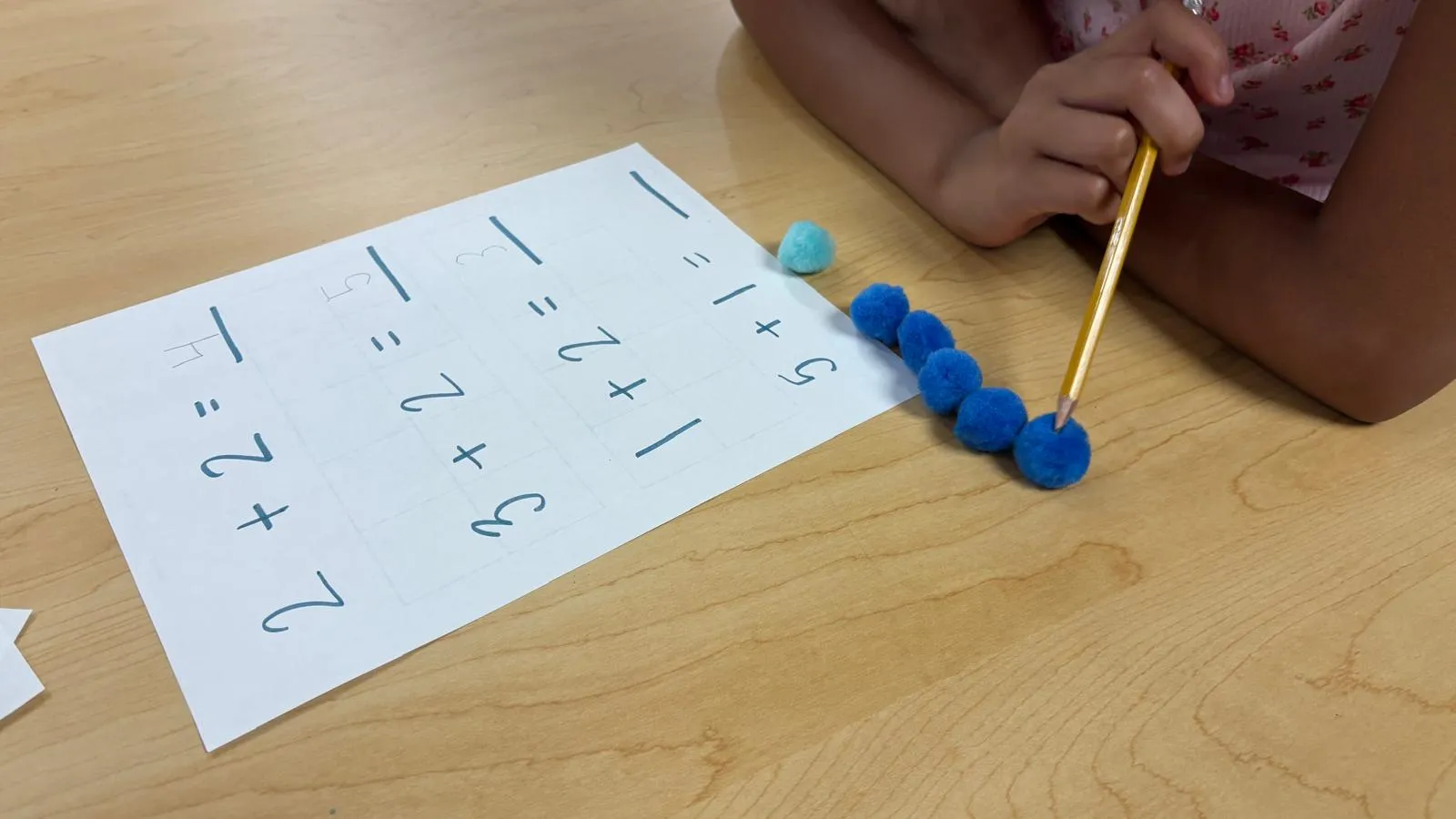
Objects help because they turn a word into an action. When your child slides 2 pom-poms over to join 3, "plus" becomes something they did with their own hands, and the answer is on the table to be counted. Moving 3 blocks away from a group of 7 shows why subtraction leaves fewer, which a printed 7 - 3 can't show by itself.
The same objects build number sense: knowing how big a number is and how numbers relate to each other, such as 7 being 2 more than 5, or 5 splitting into 2 and 3. A child with number sense can tell that 9 + 2 should be a little more than 9 without counting from 1.
The concrete representational abstract approach: objects, then pictures, then numbers
Objects are the first of three stages, and teachers have a name for the whole path from objects to paper: concrete representational abstract, or CRA. Concrete means real objects. Representational means pictures that stand for the objects, like circles, tally marks, or drawings of apples. Abstract means numbers and symbols on their own, like 7 - 3 = 4. Each stage carries the meaning from the stage before, so by the time your child writes the numbers, they know what each one stands for.
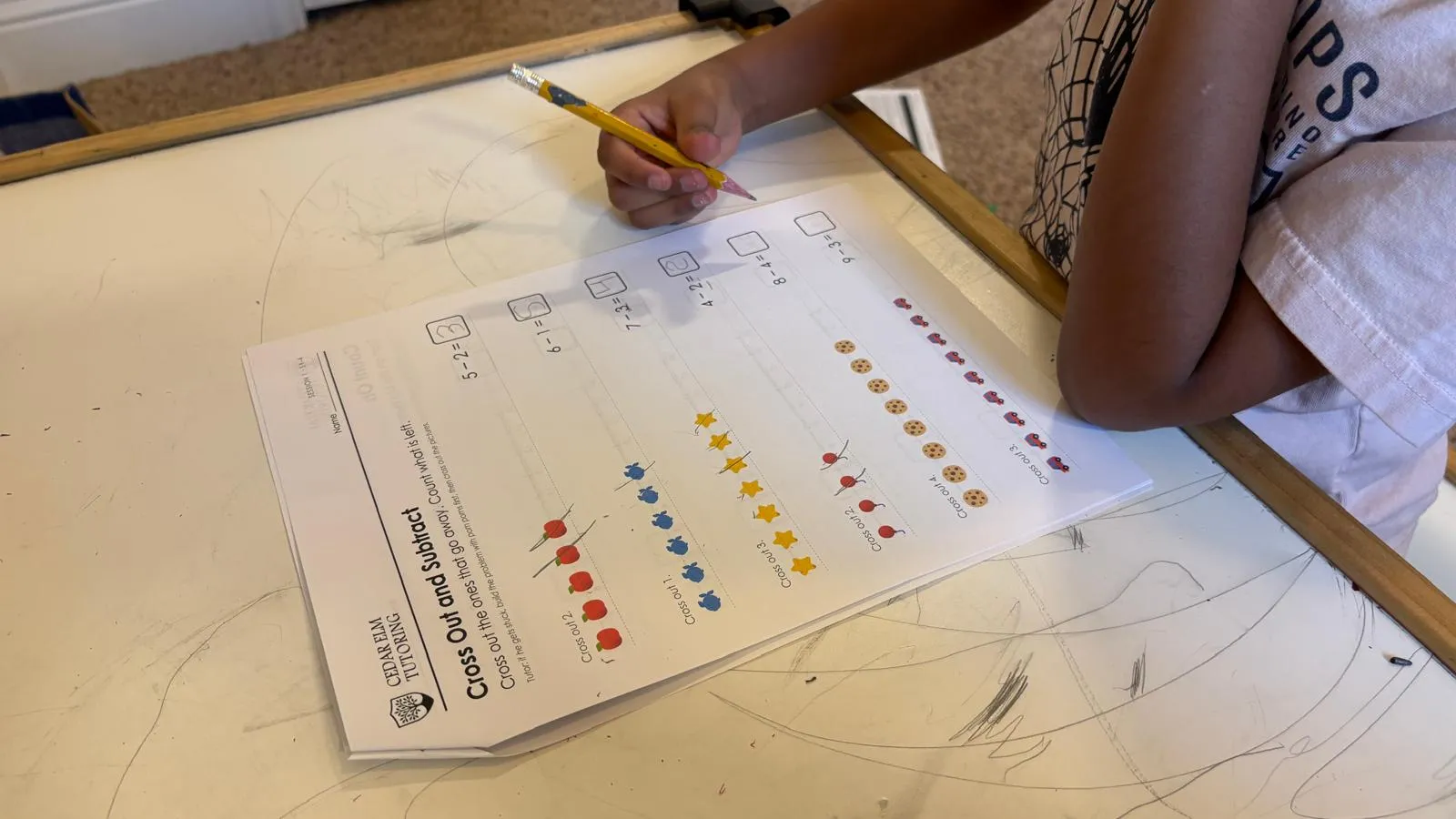
One of our subtraction worksheets, made for one student, shows the middle stage. He crosses out pictures of apples and stars to subtract, and a note printed for the tutor says: "If he gets stuck, build the problem with pom poms first, then cross out the pictures." The note sends him back to objects when a problem gets hard, then forward to the pictures again.
Our method page shows how a full session runs, from the warm-up to the wrap-up.
Going back a stage is expected. When the numbers get bigger or a new idea comes in, hand your child the objects again, and return to paper once the problem makes sense.
This approach costs time at first. Building 5 problems with pom-poms takes longer than writing 20 answers, so for a while your child may seem to be doing less practice than you expected. Once the meaning is in place, the pictures and then the numbers usually go faster, because your child knows what the symbols stand for.
Number sense activities to do at home with objects
The hands-on math activities below start at the first stage, with objects. They need 10 to 20 small objects, a table, and a few minutes. Keep each one short, and stop while your child is still enjoying it. If practice turns into an argument, let it go for the day.
For a child who still puts small things in their mouth, use larger blocks or balls of Play-Doh instead of buttons, pasta, or cereal.
- Count by moving each object. Have your child slide each object across the table as they count it. Moving them one at a time helps a child avoid skipping one or counting one twice.
- Count things around the house. Count forks while setting the table, stairs as you climb, or crayons as they go back in the box, so each number goes with one thing.
- Count toy animals. For a child who loves animals, small toy animals, like rabbits and cats, can be the objects. Ask how many rabbits there are, how many cats, and how many animals in all.
- Compare two groups. Make a row of 4 and a row of 6, one above the other, and ask which has more and how many more. Lined up, the extra 2 are easy to see.
- Hide some under a cup. Show your child 5 objects, cover some with a cup, and ask how many are hiding. This shows your child that 5 can be 3 and 2, or 4 and 1, which is the start of both adding and subtracting.
- Build a tower and take it apart. Build a tower of 6 block cubes, break it into two pieces, and count each piece. Put it back together and break it in a different place, so your child sees that 6 can be 4 and 2, or 3 and 3.
- Count by 2s and 5s. Count pairs of socks by 2s while folding laundry, or fingers by 5s. Skip counting gets your child ready for multiplying later.
- Show a teen number as 10 and some more. To show 14, group 10 pom-poms together and set 4 more beside them. This shows why the 1 in 14 stands for one ten.
- Move the hands on a practice clock. A practice clock has hands your child can move, and it puts numbers on a clock face. Say things like "We leave when the long hand gets to the 6," and let your child move the long hand there.
How to teach addition and subtraction at home with objects
Once your child can count and compare small groups, the same objects can show what adding and subtracting mean.
How to teach addition with objects
- Act it out. Put 3 pom-poms on a plate, add 2 more, and ask how many are on the plate now. Let your child count them all.
- Say it in words. Before any symbols, say it together: "3 and 2 more makes 5."
- Write it beside the objects. Write 3 + 2 = 5 while the pom-poms are still on the plate, so each number points to something your child just did.
- Count on. Once counting all of them is easy, have your child start at 3 and count only the new ones: "4, 5." This faster method grows out of the objects.
How to teach subtraction with objects
- Take some away. Start with 7 blocks, move 3 into a cup, and count what's left.
- Flatten Play-Doh balls. Roll 6 small balls, flatten 2, and count the round ones. The flat ones stay in sight, so your child can see what was taken.
- Compare two rows. Put a row of 8 above a row of 5 and count the extras. This shows subtraction as "how many more," a question word problems often ask.
- Use snack time. Put 6 crackers on a plate, eat 2, and ask how many are left. Then write 6 - 2 = 4 together.
When the objects feel easy, move to drawing: your child draws 7 circles and crosses out 3. Then try the numbers alone, and keep the objects nearby for any problem that doesn't make sense yet.
When adding and subtracting with objects comes easily, multiplication and division with objects is the next step.
Why we try more than one method with each child
The activities above teach the same two ideas in different ways, and the way that works for one child may not work for another. Some children like building with block cubes and taking them apart. Others pay closer attention when the objects are animals, so your tutor might bring miniature rabbits and cats to count. Others do best drawing the problem out. Your tutor tries these and watches which one works for your child and what they're motivated by.
That's why, in our sessions, we teach a concept with objects your child can play with and move, and we try more than one method to see which one works for your child. The approach is customized to your child and their experience: what they already know, what they love doing, and how they most easily show what they know. If the first method doesn't fit, your tutor changes how the idea is taught. The teaching is adjusted to fit your child, and the session stays calm and positive while that happens.
You can do the same at home. Start with the "Can you show me?" check on a problem your child has already solved. If one activity falls flat, try a different one for the same idea on another day, and notice which kind your child reaches for.
How we teach math concepts in your home in Dallas
In our math sessions, younger children build a problem with pom-poms, blocks, or Play-Doh before they write it, then work the same problem on paper. Your tutor brings the materials, along with custom worksheets made for the skills your child needs next. For younger children, an hour is usually 8 to 10 short blocks, a different activity in each, with at least 2 breaks.
Word problems get the same treatment. Take "Sally has 5 cookies and Sam has 3. How many cookies do they have altogether?" If your child can read it, they read it themselves first. Then they draw it out on the page or build it with blocks, so the problem stops being flat words on the page, and your tutor explains it more than one way until it makes sense.
Tutoring starts with a free consultation, where your tutor learns what your child already knows, where the gaps are, and what they love doing. After every session, you get a session note on what your child worked on.
Before I founded Cedar Elm, I tutored for 3 years at a tutoring center and spent a year as a Registered Behavior Technician (RBT) working one-on-one with autistic children at an ABA clinic. In that work I saw that some kids learn best through play and materials they can hold. For kids with ADHD or autism, short activities and planned breaks are part of the same approach, and our page on tutoring kids with ADHD and autism explains how they work.
If your child's worksheets come back right but "Can you show me?" still stalls them, your tutor can start right there, with objects. We tutor in homes in Dallas and nearby cities, including Plano, Richardson, Garland, and Irving. Our math tutoring runs from Pre-K counting through high school Geometry, starting at the level your child is working at now.
