
How to teach reading comprehension at home, from one sentence to written answers
- Reading
Your child reads every word aloud, then can't tell you what happened. To teach reading comprehension, start with one sentence your child reads and matches to a picture. Then build up: a few sentences, a short passage with questions, answers in their own words, then written answers.
Maybe they read a homework passage and answer the questions with guesses. This post shows how to teach reading comprehension at home in those small steps, starting with a single sentence and the picture that matches it. That's where comprehension starts in our sessions too.
We teach this one-on-one in homes across Dallas: see in-home reading tutoring.
What is reading comprehension, and why can a child read every word and still miss it?
Reading comprehension is understanding what you read: who is in it, what happened and in what order, and why. A child can read every word aloud and still miss the meaning, because reading the words and understanding them are two jobs happening at once.
To read aloud, a child turns letters into sounds and sounds into words. To understand, they also have to hold those words in mind long enough to picture what's going on: who is there, what they did, and where. A child still working hard on the words can reach the end of a sentence with little attention left for its meaning.
Adults read smoothly and understand at the same moment, so it's easy to take one as a sign of the other. For a young reader, the two can come apart. Picture a 2nd grader who reads "The dog hid the ball under the bed" without a mistake. Ask her where the ball is, and she starts the sentence over, because the words went by before they turned into a picture.
When this happens, it can seem like the answer is more reading: longer passages and more questions. Of course, reading more helps. But if a child can't yet hold on to the meaning of one sentence, a full page gives them more to lose track of, so comprehension work with us starts with a single sentence.
The first step: reading one sentence and circling the picture that matches it
Your child reads one sentence and circles the picture that matches it best. A sheet might show a sentence like "The cat is in the box," with 3 small pictures: a cat in a box, a cat on a box, and a dog in a box. To pick the right one, your child has to notice what the sentence says about who and where. A child who reads the words without the meaning can only guess.
The circled picture shows you right away whether your child understood the sentence. And because they don't have to write or explain anything, all of their effort goes into the reading.
One of our reading worksheets, called Read and Circle, takes the next step: your child reads 2 short sentences and circles the one that is true. It was made for one boy, and under the title, in small print, is a note to the tutor: "He can point or circle to answer. Writing the sentence is extra practice, so skip it if he's tired." Pointing counts as an answer because the sheet is there to practice reading, so on a long day the writing can be dropped and the reading still happens.
Starting this small has a cost. For a while, your child's comprehension work may look easier than the reading that comes home from school. Your tutor starts at the step your child can do, even if it's below their grade, because every later step depends on understanding what one sentence says.
How reading comprehension builds from one sentence to written answers
From that first sentence, comprehension builds up slowly toward questions about a passage and, later, written answers. The steps can look like this, with each one adding one thing: more to hold in mind, or a harder way to show what your child understood.
- One sentence and a picture. Your child reads a sentence and circles or points to the matching picture. They're ready for more when they choose the right picture without guessing from a single word.
- A few sentences together. Your child reads 2 or 3 sentences that tell a very short story, then matches them to a picture or answers one question. Now they have to keep the first sentence in mind while reading the next.
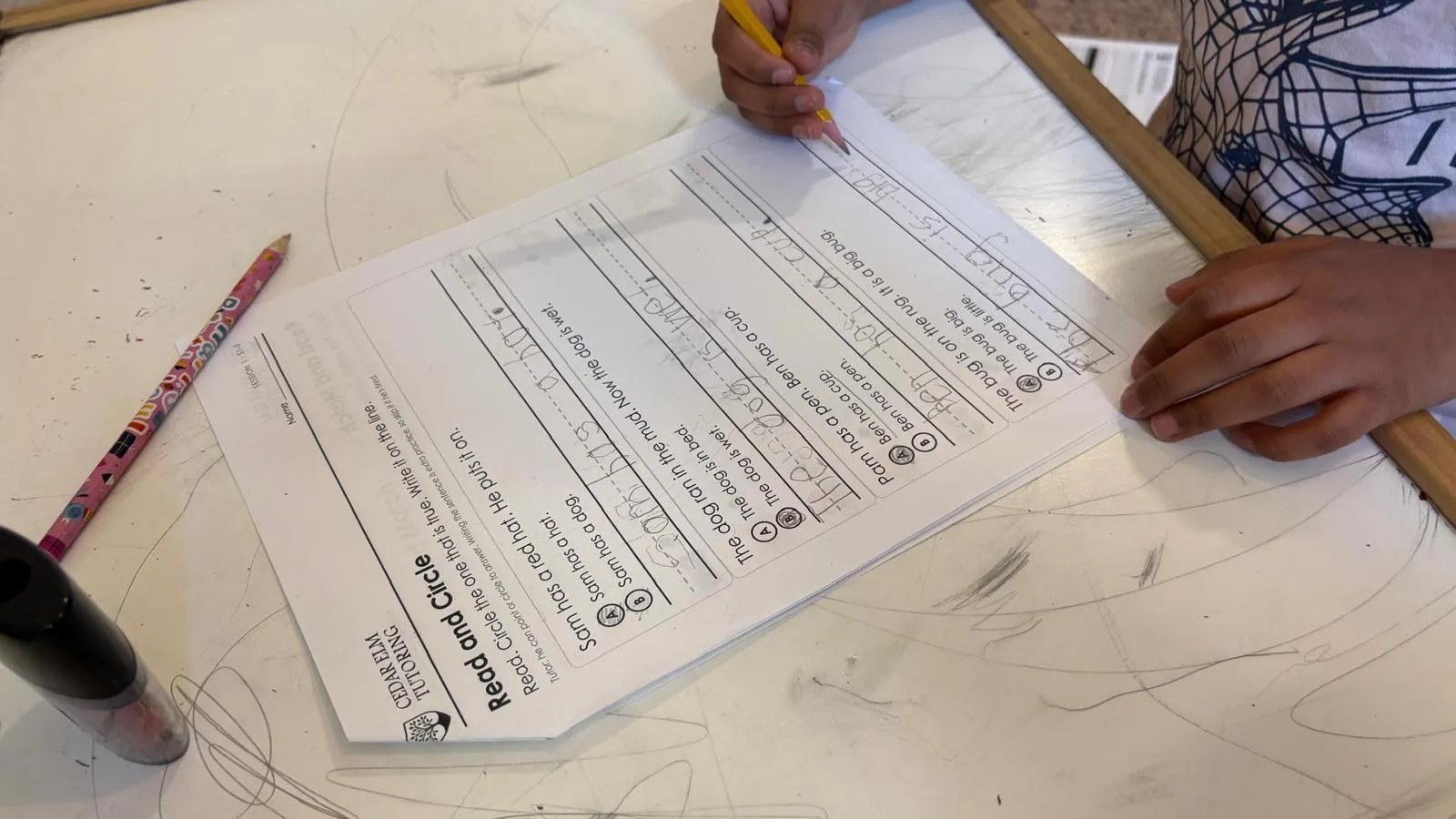
- A short passage with questions. Your child reads a short paragraph and answers questions whose answers are written in it, like who was there and what happened first. Pointing to the answer, or choosing from 2 or 3 options, still counts.
- Answers in their own words. Your child answers out loud, in a sentence of their own, instead of pointing to matching words on the page. That shows they've put the meaning together themselves.
- Written answers. Your child writes the answer, first as a word or short sentence, later as a few sentences that explain an answer using something from the passage. These are the kind of written questions that often come with reading homework and tests in later grades. If writing itself is still hard work, pre-writing activities build the hand skills first.
A child can be on different steps for different kinds of questions, answering "who" and "where" easily while still mixing up the order of events. Work on each kind of question at the step your child has reached.
Reading comprehension questions to ask, from easiest to hardest
Some questions have their answer in one sentence. Others ask your child to connect two parts of a story, or to think past the last page. Asking the easier kinds first lets your child answer one before they reach a question that stretches them. These examples use a made-up story about a boy named Sam who loses his kite at the park.
- Who and what. "Who went to the park?" "What did Sam bring?" The answer is usually in one sentence.
- Where and when. "Where did the kite land?" The answer is in the text, but your child may need to look across a few sentences.
- First, next, and last. "What happened first?" needs the whole story, in order, and a child who answers every who-and-what question can still mix it up.
- Why. "Why was Sam sad?" What happened and the reason for it are often in different sentences, so your child has to connect them.
- What do you think. "What will Sam do the next time it's windy?" The answer isn't written anywhere, so your child uses what they read to make a sensible guess.
If your child gets stuck, go back to an easier question about the same part of the story. Once they've said who was there and what happened, the "why" is often easier to reach.
Reading comprehension for kindergarten, before your child reads on their own
If you're wondering how to teach comprehension to a child who can't read sentences yet, start with stories you read aloud. When you read a picture book together and ask who was in it or what happened first, your child practices understanding a story by listening, with the same questions they'll later answer about their own reading.
The picture step works this way too. Say a sentence, like "The bird is on the roof," and ask your child to point to the picture that matches it.
With young children, our reading tutoring starts with letters and sounds, and for some, early sessions also build habits like sitting at a table and following directions. Our kindergarten readiness tutoring covers those first steps.
Reading comprehension activities to try at home
Each of these takes a few minutes and uses things you already have. Keep them short, stop while your child is still willing, and skip a day when they're tired, the same way the Read and Circle note lets the tutor drop the writing.
- Draw the sentence. Write a short sentence, like "The red car is under the bed," and ask your child to draw it. The drawing shows which words they understood: is the car red, and is it under the bed or on it?
- Make your own read-and-circle sheet. Write a sentence and draw 2 or 3 quick sketches beside it, only one of which matches. Ask your child to circle the right one.
- Act it out with toys. Write "The bear sits on the chair" and hand your child the teddy bear. Moving the toy shows what they understood, and it suits children who learn best by doing.
- Ask one question per story. At story time, stop once and ask one question from the list above, starting with who or what. One question gives your child practice and keeps the story moving.
- Ask for a retelling. After a short story, ask your child to tell it back to you, or to a stuffed animal, in their own words. Listen for whether the events come out in order.
As comprehension grows, you may notice your child retelling a story in order without being asked, going back to reread a part that didn't make sense, or bringing up something from a book after you've closed it.
Reading comprehension for kids with ADHD or autism
Tutoring kids with ADHD, autism, an IEP, or a 504 plan is our specialty, and comprehension work with them starts the same way, with one sentence. For younger children and kids who need more breaks, your tutor plans the hour in short blocks of 5 to 10 minutes, with a different activity in each and usually a break after 2 or 3 of them. When your child hits their limit, your tutor asks for one more very short task, under 2 minutes, praises them for finishing it, and gives a short break. Short blocks, planned breaks, and praise are ABA-informed strategies, and we use them to teach reading. We don't provide ABA therapy.
Your tutor also plans around how your child best shows what they understood. Pointing to the right picture counts as an answer, so a child who finds talking or writing hard can still show they understood the sentence. We have worked with nonverbal children. If your child has an IEP or a 504 plan, tutoring works alongside it. You can read more about how we tutor kids with ADHD and autism.
Reading comprehension tutoring in your home in Dallas
At the free consultation, we spend time with your child on a short, easy activity and note where they are in reading, including comprehension. From there, your tutor makes worksheets for the step your child is on, like the Read and Circle sheet, and adds the next step when the current one is solid. We don't diagnose, and if your tutor thinks an evaluation would help your child, we'll tell you.
Sessions start with a warm-up on something your child already knows, move to the harder reading work while they're fresh, and end with an easy review. For younger children, an hour is usually 8 to 10 short blocks, with at least 2 breaks, and every session includes reading practice. You get a session note after every session and a progress report every month, and our method page walks through a full session.
I founded Cedar Elm after a year as a Registered Behavior Technician (RBT) working one-on-one with autistic children at an ABA clinic, and 3 years tutoring at a tutoring center. We tutor reading from Pre-K through 8th grade, including children with dyslexia, in homes in Dallas and nearby cities like Plano, Richardson, and Irving. For 3rd through 8th graders, our STAAR test prep covers the reading test, written answers included. Read more about our reading tutoring, or book a free consultation if your child reads every word and still can't tell you what happened.
